The short answer: agencies publish estimates of ₹37,96,500 to ₹94,91,250 for a small-business custom ERP and ₹94,91,250 to ₹2,37,28,125 for a mid-size one. Those are market figures, and what you actually pay depends heavily on the team, the scope and where the team is based. Off-the-shelf software looks cheaper on day one, but per-user fees keep coming every month for as long as you use it. In the worked example below, a custom build overtakes a ₹9492-per-user plan for 25 users at about the three-year mark.
That does not mean custom is right for everyone. For many small companies, Odoo or a similar platform is the smarter buy. This guide gives you the real numbers, the maths to run your own case, and a checklist to decide.
Three ways to get an ERP
Most people think the choice is "build or buy". It is really three choices:
- Buy a ready-made system such as NetSuite, SAP Business One or Odoo, and pay per user.
- Customise a platform like Odoo, so you start with a working system and change the parts that do not fit.
- Build a custom ERP from scratch, designed around how your business works.
The cost question is really about which of these fits you. Let us start with what building costs.
What custom ERP software development costs
There is no price list for custom software, but agencies publish ranges. Here is how several of them line up.
Business size | Typical build cost (USD) | Typical timeline |
|---|---|---|
Small business, few users, core modules | ₹37,96,500 to ₹94,91,250 | 3 to 6 months |
Mid-size, several departments and integrations | ₹94,91,250 to ₹2,37,28,125 | 6 to 9 months |
Large or complex, 10 or more modules | ₹2,84,73,750 to ₹4,74,56,250 and up | 6 to 18 months or more |
These are estimates from agencies (Boundev, PerfectionGeeks and QArea, listed in the Sources), mostly based in the US and Europe. Treat them as a guide, because rates differ by country and by team. One of them, QArea, puts hourly rates at ₹2373 to $6644 depending on the vendor, and the cost of a single module at about ₹8,54,213 on average.
Why quotes vary so much. The same scope can be priced very differently depending on where the team is based, how large it is, how clearly your requirements are written, and whether the work is delivered in phases. An individual developer or a small studio usually carries less overhead than a large agency, so quotes can differ by a wide margin. Ask two or three teams to quote against the same written requirements, and compare them module by module, not just by the total.
What pushes the price up:
- Number of modules. Finance, inventory, HR, sales and production each add work.
- Integrations. Every link to a bank, a payment gateway or an old system costs time.
- Data migration. Cleaning and moving old data is often underestimated.
- Team size. A real project needs a project manager, analyst, designer, developers, testers and DevOps.
- Training and support. Someone has to teach your staff and fix problems after launch.
Also plan for yearly upkeep. Two sources put maintenance at 15 to 20 percent of the build cost per year, and it is the line people forget most.
What the main alternatives cost
Prices below are what is published or commonly reported. Two of the four vendors do not publish a price at all, which is worth knowing before you compare.
Option | How you pay | Price (approximate) | Setup or implementation |
|---|---|---|---|
Odoo | Per user per month, set by region | One App free. Standard $31.10 and Custom $61.00 per user per month (US, billed yearly). India: ₹725 and ₹1,150. Community edition is free | ₹4,74,550 to ₹1,89,82,000 |
SAP Business One | Per named user, sold through partners, no public price | About ₹9,016.69 to ₹23,728.13 per user per month (cloud) | ₹1,424,100 to ₹14,241,000 |
NetSuite | Base fee plus per user plus modules, no public price | About ₹94,905 a month base plus ₹9,405 to ₹18,905 per user per month | ₹2,372,813 to ₹14,236,875 or more |
TallyPrime (India) | One-time licence | Silver ₹22,500 (single user), Gold ₹67,500 (multi-user on one LAN), plus 18% GST | Not listed |
A few notes. Odoo changes its price by country, so check odoo.com for your region. The SAP and NetSuite figures come from third-party price trackers, not from the vendors, so use them as ranges. TallyPrime is an accounting and inventory product, so it is a different kind of tool from a full ERP, but many Indian businesses start there.
Prices checked on 1 November 2026. Vendors change them, so confirm on their websites before you decide.
A worked example: 25 users over 3 years
Let us put the numbers side by side for a company with 25 users. This is an illustration, not a quote.
Option | Licences over 3 years | One-time setup | Three-year total |
|---|---|---|---|
Odoo (Standard to Custom plan, US prices) | ₹26,57,370.60 to ₹52,12,206.00 | ₹4,74,700 to ₹1,89,88,000 | ₹31,33,020 to ₹2,42,09,700 |
SAP Business One (cloud) | ₹81,17,370 to ₹2,13,61,500 | ₹14,23,650 to ₹1,42,36,500 | ₹95,38,706 to ₹3,55,92,187 |
NetSuite | About ₹1,18,64,062 to ₹2,04,06,187 | ₹23,72,812.50 to ₹1,42,36,875.00 | About ₹1,42,41,000 to ₹3,46,53,100 |
Custom ERP (small scope) | None | ₹37,96,500 to ₹94,91,250 to build | ₹5,504,925 to ₹15,186,000 including 15 to 20% yearly upkeep |
How I worked these out: licence cost is users times monthly price times 36 months. NetSuite adds the ₹94,845 monthly base fee. The custom total is the build cost plus three years of upkeep, So ₹37,97,600 plus 45% at the low end and ₹94,94,000 plus 60% at the high end.
How to read it honestly. The ranges are wide because setup cost depends on scope more than anything else. A small custom build also covers only the modules you pay for, while Odoo or SAP arrive with far more already built in. So this table is a guide to the money, not a verdict. Odoo at the low end is hard to beat. Custom becomes interesting when you compare it with SAP or NetSuite level pricing, or when you need something the platforms cannot do.
When does custom ERP start to win?
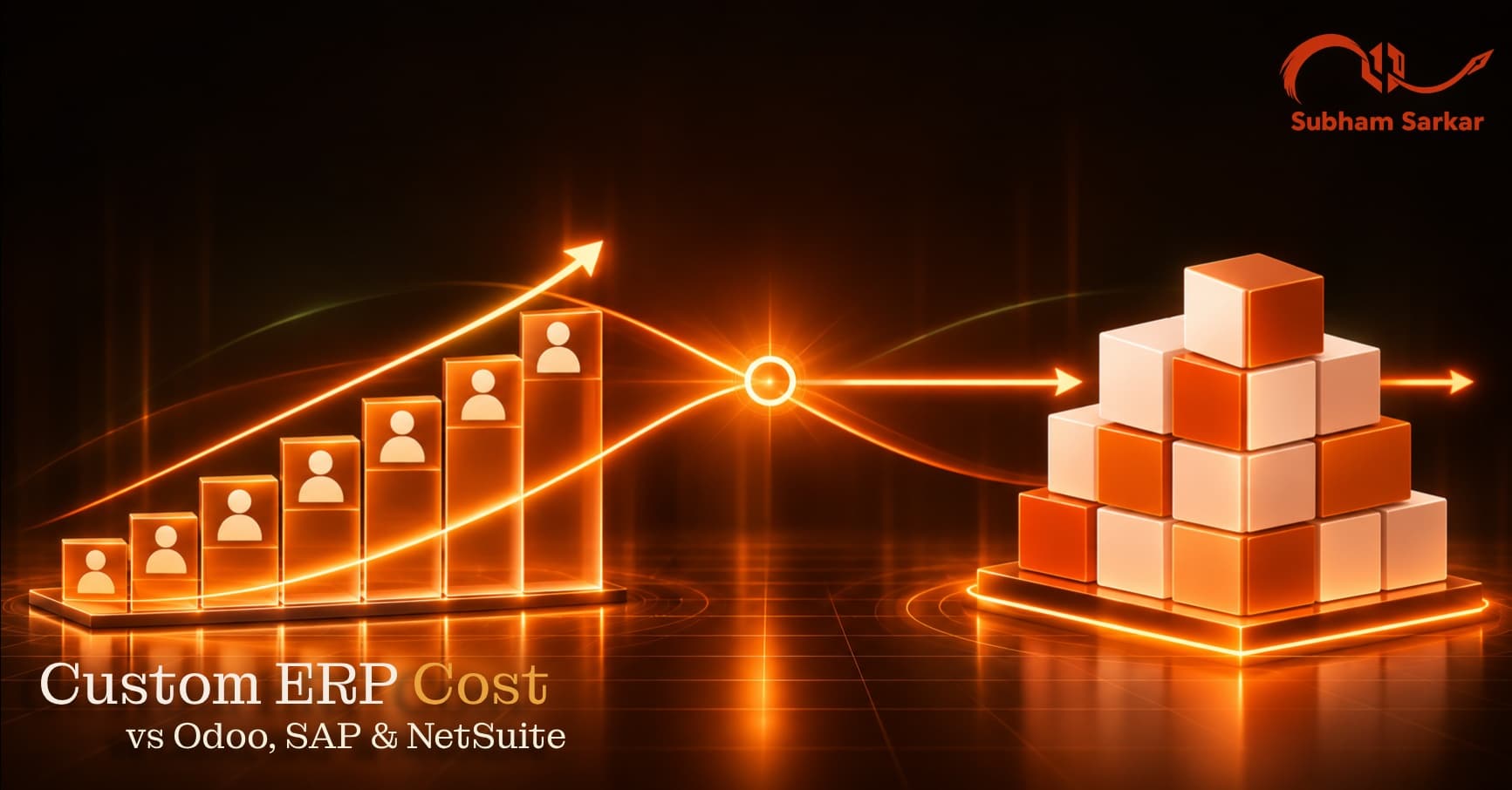
The key idea is simple. Custom costs a lot at the start and little each year. A subscription costs little at the start and the same amount every year. At some point the lines cross.
Break-even point in years = build cost divided by (yearly subscription cost minus yearly upkeep)
Here is an example with made-up but realistic numbers. A custom ERP costs ₹5,694,750 to build, with upkeep at 17.5% a year, which is ₹996,581. A SaaS ERP costs ₹9,491 per user per month for 25 users, which is ₹2,847,375 a year.
Year | Custom ERP, total spent | SaaS ERP, total spent |
|---|---|---|
1 | ₹6,691,331.25 | ₹2,855,617.50 |
2 | ₹76,87,912.50 | ₹5,694,750 |
3 | ₹8,684,493.75 | ₹8,542,125 |
4 | ₹96,81,075 | ₹1,13,89,500 |
5 | ₹10,680,750 | ₹1,42,44,000 |
The lines cross just after year 3, because ₹56,96,400 divided by ₹18,51,330 is about 3.1 years. Two things change this. A SaaS setup fee of ₹23,73,500 or more would pull the crossing earlier. A cheaper platform like Odoo, or fewer users, would push it later. With only 10 users, the same plan costs ₹11,39,280 a year, and a custom build with ₹9,96,870 of upkeep would take decades to catch up. That is why user count matters so much.
The hidden costs on both sides
With off-the-shelf software:
- Prices can rise at renewal. Third-party sources report that NetSuite raised its full-user price from ₹9,399.06 to ₹12,247.26 per month in 2026.
- Modules, extra users and add-ons are priced separately.
- Setup is done by a partner and can cost as much as a year or two of licences.
- Customisation is limited, and heavy changes can be expensive.
With a custom build:
- Upkeep, hosting and security updates continue after launch.
- You depend on the team that built it, so ask for documentation and code ownership up front.
- Scope can grow. Itransition warns that a vague scope is a common risk, and suggests sorting needs into must-have, beneficial and nice-to-have.
- Training is on you, though a system designed around your workflow is usually easier to learn.
Build or buy: a checklist
Answer yes or no to each question.
- Do your core workflows differ enough from standard ERP that you would be changing a large part of a ready-made system?
- Do you have 25 or more users, or expect to soon, so that per-user fees add up?
- Are you in a regulated field, or do you need your data on your own servers?
- Do you need deep links to legacy or industry-specific systems?
- Can you wait 6 to 12 months for the first full release?
- Is your budget at least ₹3,796,500, plus 15 to 20 percent a year for upkeep?
- Is your process stable enough to write down clearly?
- Is there one person on your side who can make scope decisions?
My rule of thumb: 6 or more yes answers, ask for a custom quote. 3 to 5, look at customising a platform like Odoo. 0 to 2, buy a ready-made system and move on. This is a starting point for the conversation, not a formula.
The middle path: customise a platform
Building from scratch is not the only way to get something tailored. Itransition suggests that when a platform already covers roughly 70 to 80 percent of your requirements, customising it is usually the better route. You get a working core on day one and only pay to change the gaps.
The things to check are whether the platform has open APIs, whether it supports the rules in your industry, and how upgrades behave once you have changed it.
How to get a quote you can trust
Whoever you talk to, prepare these first. They make estimates far more accurate.
- The five to ten workflows that matter most, written as simple steps
- The number of users and what each role needs to do
- The systems it must connect to, such as accounting, payments or e-commerce
- The data you want to move over, and how clean it is
- A must-have, nice-to-have and later list
Then ask for a module-by-module estimate, delivery in phases with clear milestones, a statement of who owns the code, and the yearly cost to keep it running. A good partner will answer all four without fuss.
Weighing custom against Odoo or SAP?
If you are comparing options and want a second opinion, send me your main workflows and your user count. You can see what I build on the services page, or book a free consultation and we will go through the numbers together.
Frequently Asked Questions
Published agency estimates put a small-business ERP at about $40,000 to $100,000 and a mid-size one at $100,000 to $250,000. Large, complex systems can reach $300,000 to $500,000 or more. The main drivers are the number of modules, integrations, data migration and team size. Plan for 15 to 20 percent a year in upkeep.