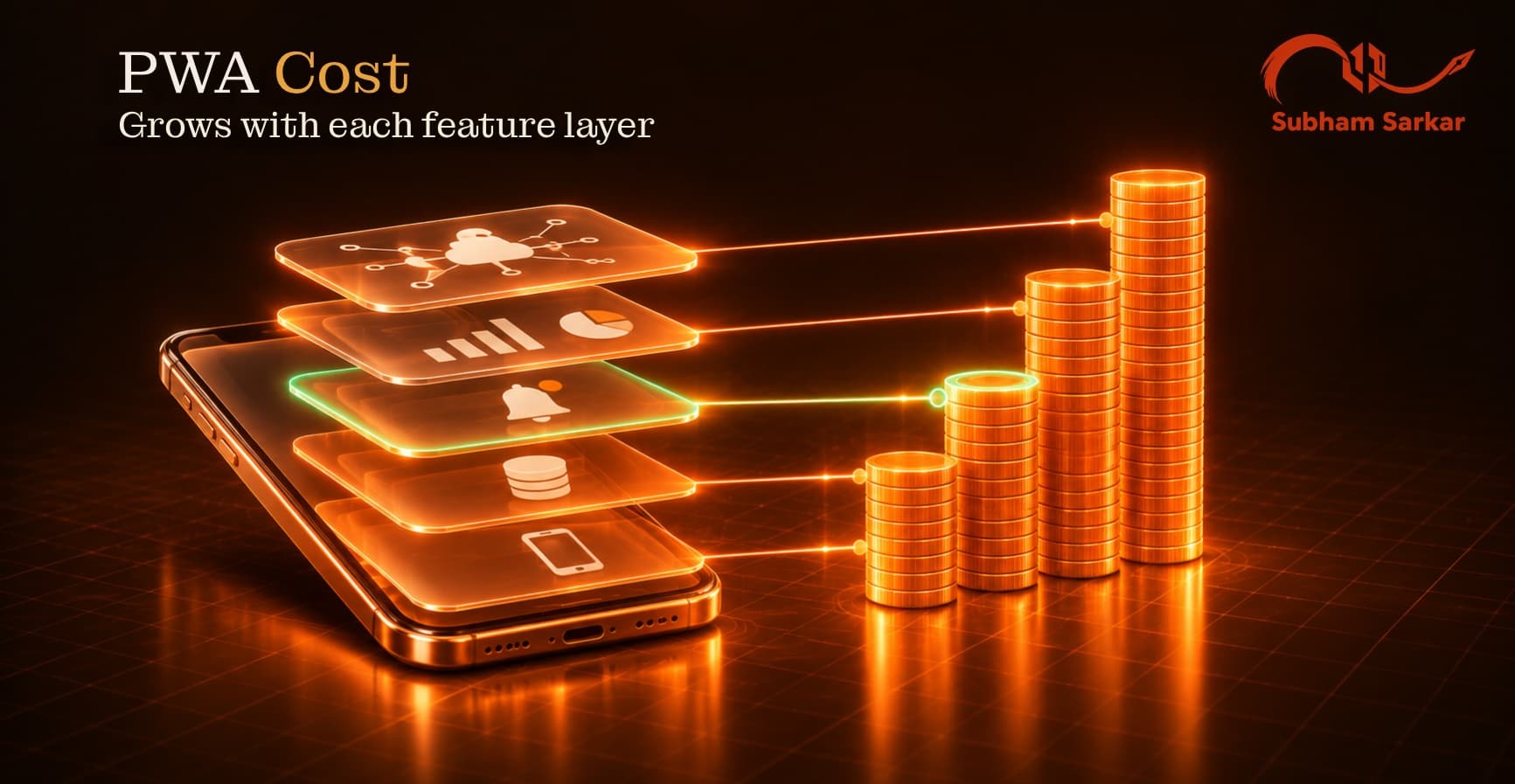
The short answer: agencies in India publish prices from about ₹1,00,000 ($1,050) for a simple installable PWA up to ₹25,00,000 ($26,300) for a large system with integrations, and agencies abroad publish figures many times higher for the same kind of work. A typical PWA with accounts, payments, push notifications and offline support sits around ₹3,00,000 to ₹7,00,000 ($3,150 to $7,400) on the Indian side, and $15,000 to $45,000 (₹14,25,000 to ₹42,75,000) on the international side.
That gap is not a mistake. This guide shows where the numbers come from, what really moves the price, what it costs to run a PWA after launch, and how to compare quotes without being misled.
Why the numbers differ so much
Two things explain most of it.
Where the team is based. oCode Technologies puts Indian development rates at about $22 to $60 an hour (₹2,090 to ₹5,700), and senior US developers at about $70 to $120 or more (₹6,650 to ₹11,400 and up). The same scope can cost two or three times more, depending on the team.
What "done" means. A demo that installs on a phone is not the same as an app that is tested on many devices and networks, handles failures, and can be maintained. Quotes far below the ranges below often leave out the testing and the hard parts.
Because of this, I show two sets of published figures side by side. Neither is a quote. They tell you what a fair range looks like.
What Indian agencies publish
These figures are from 24Bit System's 2026 guide, before 18% GST.
Stage | Price | Typical time |
|---|---|---|
Discovery, responsive design and prototype | ₹30,000 to ₹1,00,000 ($320 to $1,050) | 2 to 3 weeks |
Installable PWA with core screens | ₹1,00,000 to ₹3,00,000 ($1,050 to $3,150) | 4 to 8 weeks |
Offline cache, push notifications and payments | ₹3,00,000 to ₹7,00,000 ($3,150 to $7,400) | 8 to 12 weeks |
Multi-role dashboard with reporting | ₹7,00,000 to ₹14,00,000 ($7,400 to $14,700) | 12 to 18 weeks |
Integrations, sync and enterprise controls | ₹14,00,000 to ₹25,00,000 ($14,700 to $26,300) | 16 to 24 weeks |
The same agency notes that apps with offline data and sync sit higher in these ranges, because the sync layer is a small system of its own.
What agencies abroad publish
These figures are from oCode Technologies, published in November 2026. Rupee figures are converted at about ₹95 to $1.
Level | Price | Typical time |
|---|---|---|
PWA layer on an existing website | $3,000 to $10,000 (₹2,85,000 to ₹9,50,000) | 2 to 4 weeks |
Simple new PWA | $5,000 to $15,000 (₹4,75,000 to ₹14,25,000) | 4 to 8 weeks |
Mid-complexity PWA, with accounts, payments, push and integrations | $15,000 to $45,000 (₹14,25,000 to ₹42,75,000) | 8 to 16 weeks |
Complex PWA, with real-time features, custom backend and roles | $45,000 to $120,000 and up (₹42,75,000 to ₹1,14,00,000 and up) | 4 to 6 months |
Enterprise programmes | $100,000 to $250,000 and up (₹95,00,000 to ₹2,37,50,000 and up) | 6 months or more |
The labels do not match line for line, because each agency draws its tiers differently. Read each table on its own, and use the other one to see the spread.
What pushes the price up
Two PWAs at the same level can differ by two or three times. These are the usual reasons.
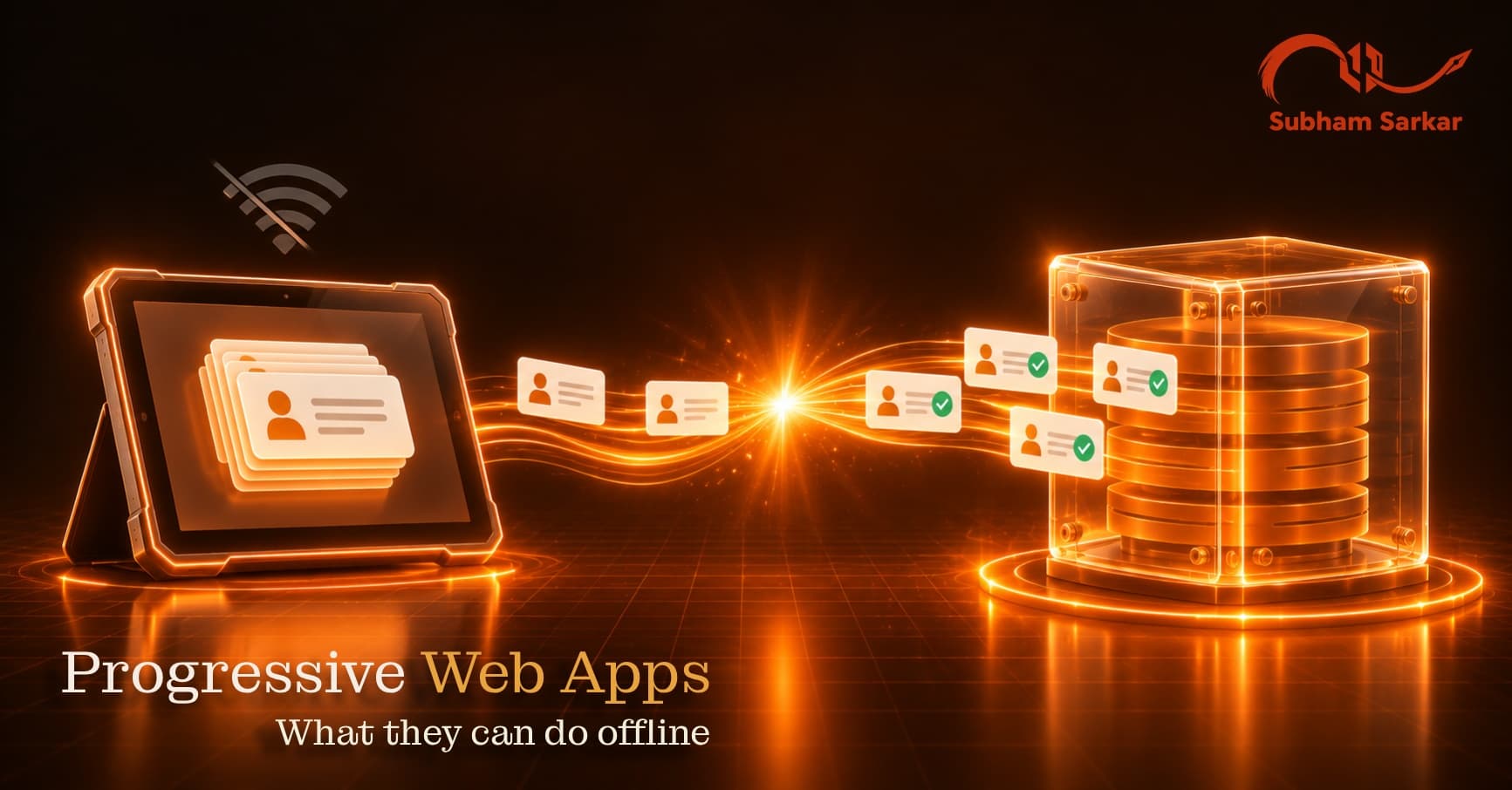
Offline depth. This is the biggest one, and the easiest to underestimate. "Works offline" can mean showing pages the person has already opened, which takes days. It can also mean letting staff enter data with no signal and merging it correctly when they reconnect, which takes weeks plus careful testing. If your team works in places with poor signal, be exact about which one you need. I explain the difference in my guide to progressive web apps for business and offline use.
iPhone limits. Push notifications on iPhone only work after the user adds the app to the home screen, and background work is limited. If your audience is mostly on iPhones, the price should include a plan B, such as email or SMS alerts.
Device features. Camera, location and file access work with limits. Bluetooth and reliable background location do not work well in a browser, so projects that need them may be better as native apps.
Backend and integrations. An app over an existing system is cheaper than one that needs accounts, a database, an admin panel and links to payments, a CRM or an ERP. Each connected system needs error handling as well as the happy path.
Design. Template-based design is cheaper than a custom interface. For an internal tool, templates are usually fine.
Search visibility. If the app has public pages that must be found on Google, the pages need to be rendered on the server or built in advance. That is cheap to plan at the start and expensive to add later.
Testing. oCode estimates testing across devices, browsers and networks at 20 to 25% of the development cost on a well-built PWA. A quote with no testing in it is not cheaper. It is incomplete.
Update handling. A silent update is convenient, but it can break a screen someone is in the middle of, so versioning needs design.
What it costs to run after launch
- Upkeep: agencies commonly suggest budgeting 15 to 25% of the build cost each year for fixes, security updates and platform changes. On a ₹5,00,000 build, that is ₹75,000 to ₹1,25,000 a year.
- Hosting and a content delivery network: 24Bit System puts this at ₹12,000 to ₹60,000 a year.
- Third-party services: SMS, maps and payment gateways charge by use.
- App store fees: none, because a PWA installs from the browser. If you later list a packaged version, Apple charges about $99 a year (₹9,400) and Google a one-time $25 (₹2,400).
A note on stores: Google Play accepts a PWA packaged as a Trusted Web Activity. Apple's App Store does not accept PWAs as PWAs, so you need a native app with real added functionality. Decide early whether you need store listings, because it affects the design.
Is a PWA cheaper than a native app?
Usually, yes. Agency guides commonly say a PWA costs 30 to 70% less than an equivalent native build, because one codebase serves every device and there is no store review.
The saving shrinks when the product needs offline sync or device features. 24Bit System says those cost about the same to build well either way. So the real question is which one your product needs. My guide to web app vs mobile app walks through that decision by business type.
How to compare quotes
Prices only mean something when the scope is the same. Ask each team:
- How are changes made offline merged when two people edit the same record?
- Which features are limited on iPhone, and what is the plan for them?
- How will updates reach users without breaking a screen?
- Is page rendering for search part of the scope?
- Which devices and networks will it be tested on?
- Who owns the code when the project ends?
- What do hosting and upkeep cost each year?
- Is the price fixed for each phase?
A team that answers these clearly is giving you a real quote. A team that gives a single number without asking about your features is guessing.
How to estimate your own budget
Write down three things before you ask anyone for a price: your feature list, exactly what must work with no signal, and every system the app must connect to. Then ask for a price in phases, such as the installable core first, then offline and push, then dashboards, then integrations. You can stop or change direction after each phase, which makes the risk smaller.
Planning a PWA budget?
If you have a feature list and want a second opinion on what it involves, you can send me a short description. You can see how I approach this on the web and mobile application development page, or book a free consultation.
Frequently Asked Questions
Indian agencies publish about ₹1,00,000 ($1,050) for a simple installable PWA, ₹3,00,000 to ₹7,00,000 ($3,150 to $7,400) with offline support, push and payments, and up to ₹25,00,000 ($26,300) for large systems. International agencies publish about $5,000 to $15,000 for a simple PWA and $15,000 to $45,000 for a mid-complexity one. Treat all of these as ballparks, not quotes.